When Technical Risk Starts to Stack Up
A founder's lesson from a medical device startup that slowly became too complex to succeed.
How a promising medical idea slowly became technically unmanageable
How did our first startup slowly sink under the weight of its own technical ambition?
By the time things began to unravel, we were already three years in. What had started as an idea — measuring specific compounds in the breath of patients for diagnostic purposes — had grown into something that felt real. We had spoken to countless experts. We had formed a management team. We had incorporated a company. We had even secured funding through grants — which, at that time, was still somewhat easier than it is today.
On paper, everything looked solid.
There were five of us founders, connected by a neat stack of management contracts and a freshly signed incorporation deed. We had a name, a structure, a bank account. In other words: we had become “serious.”
And yet, I remember having a slightly uneasy feeling about our management team.
Validation that felt like acceleration
They were good people. Two energetic entrepreneurs with impressive track records and a genuine drive to build something meaningful. Their added value became visible almost immediately. Through their network, we were introduced to the R&D managers of a subsidiary of a very large multinational. These were serious industry professionals — the kind of people you hope to meet when you're trying to bring a medical device to market.
To our relief, they were enthusiastic.
They told us that if we could demonstrate that our device actually worked, they would take it over.
I remember asking, “What exactly do you mean by that?”
The answer was surprisingly direct.
“If you can prove it works — you can sell it on the moon for all we care. We’ll handle the rest.”
At that moment, it sounded like validation. Like opportunity. Like acceleration.
Only later did I begin to understand what that sentence really implied — and how much technical uncertainty we were about to stack on top of uncertainty that was already there.
Acceleration without shared risk
What I did not fully understand at the time was what was really happening in that conversation with the multinational. By saying “prove it works and we.ll take it over,” they were effectively placing all technical development risk and all clinical validation risk on our side of the table.
They did add that our technology fitted perfectly with what they were looking for. They even suggested that clinical proof could probably be generated much faster than we anticipated.
That was the moment where we should have said: agreed — but we are a small startup. If you want it faster, we will need additional funding to hire more people and accelerate development.
We did not say that.
We nodded enthusiastically and went to work.
A lab model is not a product
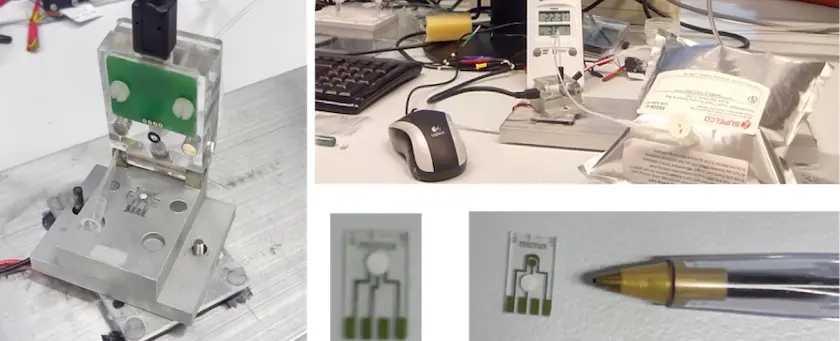
The heart of our medical device was a highly advanced “lab-on-a-chip” system based on microfluidics — tiny, precisely controlled liquid flows on a miniature chip.
The only problem was that the chip existed in a university lab. It was essentially a clever academic construction: robust enough for a PhD student to demonstrate the concept once, publish a paper, and graduate. It was not an industrial prototype. It was not manufacturable. It was not robust.
So we began looking for a company that could reproduce this chip according to industry standards. We quickly found one — a spin-off from the same university.
Meanwhile, our management team — encouraged by the multinational's subsidiary — decided that the final product should be handheld. Compact. Elegant. Portable.
Which meant that, besides reproducing the university chip, it also had to become much smaller.
And therefore, as we would later discover, much more fragile.
Changing five variables at once
This newly miniaturized chip then had to be integrated into a first prototype. That meant pumps, fluid control components, read-out electronics — perfectly understandable additions.
The prototype was built by yet another technology company. They considered it absolutely essential to include a specific mixing chamber in the device. At the time, we did not fully understand why. Only later did it become clear that they held a patent on that component and were keen to see it integrated — ideally in a product that might one day be sold to a multinational.
Our management team saw no problem with this and remained enthusiastic.
We — the original idea owners, both PhDs — were less convinced. We had no deep expertise in microfluidics or electronics. But we had been trained in research methodology. And one basic principle we had learned was simple: change one variable at a time.
Our suggestion was modest. First, reproduce the university chip exactly and see if we could replicate the published results. If that worked, move to the next step. And then the next.
That approach, however, was considered too slow. Too academic. Too cautious.
We explained — many times — why sequential validation mattered. But the prevailing view was that we were “researchers who wanted to keep researching,” instead of entrepreneurs eager to reach the market.
Eventually, the decisive argument surfaced: we held a minority of the shares. The management team held the majority. And therefore, this was the chosen direction. And that is where I learned how decision-making structure influences technical choices.
So that was what the stack of management contracts had been for.
When complexity becomes structural risk
The device was built.
And in a way, it worked.
And in another way, it did not.
It was too fragile. Not robust enough for daily clinical use. It did make it into a clinical environment at one point, but physicians and nurses were never truly able to work with it. Something was always unclear. Something always required adjustment.
And in the end, we were unable to complete the first clinical trial focussed on showing in a small group of patients that the idea was valid and that the device worked.
What we learned — too late
Our research instinct had been correct. Technical development is not just about building something that functions once under controlled conditions. It is about building something that functions reliably under variable, real-world conditions.
By miniaturizing the chip, changing the architecture, adding patented components, integrating electronics, and accelerating timelines — all simultaneously — we had stacked multiple technical uncertainties on top of each other.
Each uncertainty alone might have been manageable.
Together, they became structural risk.
Because we were perceived as researchers without business experience — and because we held a minority position — we were unable to influence the development strategy.
That combination turned out to be one of the fundamental reasons this venture did not succeed.
However, the real problem was not the abovementioned share distribution itself. The company continued adding financial and organisational complexity without first reducing the technical and commercial uncertainties. As a result, risk increased faster than value was created.
This illustrates one of the central principles of innovation: sustainable growth comes from systematically reducing uncertainty before introducing new layers of complexity. Learn more in Risk Reduction in Innovation.
Why investors sense this before founders do
Looking back, I now understand something that I did not see at the time. Investors are often uncomfortable with technical risk — but not because technology is uncertain. Uncertainty is part of innovation. What makes them cautious is stacked uncertainty.
When multiple technical assumptions are tested simultaneously, when validation is not sequential, and when development paths are no longer modular, risk stops being manageable. It becomes correlated. A single failure can invalidate several layers of work at once.
Investors may not always articulate this precisely. They may simply say the risk feels “too high” or the execution “too complex.” But what they often detect — intuitively — is stacked risk.
At the time, we did approach investors. We presented the promise, the technology, the opportunity. What we did not fully articulate — perhaps not even to ourselves — was how many technical unknowns we were trying to solve simultaneously. And investors, even without seeing every internal detail, tend to sense that kind of complexity. The chip plus the device plus the minituarization towards a handheld device.
Our idea was not impossible. The underlying science was sound. What made it unworkable was that we attempted to solve too many unknowns at the same time, with too little capital, under governance that did not allow for stepwise validation.
And that, more than the technology itself, is what ultimately made this venture fail.
This dynamic also explains a pattern discussed in why investors say no: what appears to be hesitation is often a reaction to layered technical uncertainty rather than a rejection of the idea itself.
It also illustrates a broader principle explored in why inventions are high risk: risk does not only stem from novelty, but from how many uncertainties are stacked and tested simultaneously.