When a University Patents Your Idea First: A Startup Case Study
This is a real case from an early-stage startup — and a lesson in how intellectual property positions are created.

Part of the Innovation Case Studies Collection
This article is part of our growing Innovation Case Studies collection. And it is featured in our Founder Lessons series, where my own real-world startup experiences illustrate practical lessons about intellectual property, ownership, equity and strategic decision-making.
The Initial Opportunity: Existing Technology Without Patent Protection
It was a warm summer day, more than twenty years ago, when a colleague and I set out on what felt more like a small expedition than a business trip. We were driving several hundred kilometers to visit a university, following up on something that had started, quite literally, with a misclick.
At the time, I had come across a webpage on the university's website describing a sensing technology. By accident, I had opened the wrong link — but what I found there immediately caught my attention. The page explained how the university had managed to miniaturize a measurement method for detecting a specific chemical compound in air, reducing it to just a few square centimeters.
That moment felt like a lightning strike. This was exactly what we had been looking for — although to understand why, you need to go back a couple of years.
In my previous role at a large academic hospital, I had been in a position where I regularly saw PhD theses pass by — the output of PhD students and researchers working across different departments. One of those theses had been written by a former colleague of mine. We had once shared a small office in a clinical setting, discussing research results and early ideas.
After I saw his PhD thesis, I reached out to him. I told him I believed there was a promising application for his work: medical diagnostics based on the compounds he had measured in exhaled breath during physical exertion. I also had the impression that some kind of device already existed to perform such measurements.
He confirmed that the idea made sense. There was indeed equipment capable of measuring gases — but it had been developed for use in outdoor environments. It was anything but portable. In fact, the device was roughly the size of a small cabinet, built to be robust enough that, as he jokingly put it, “it could survive a cow standing on top of it.”
So while the scientific principle existed, a practical application — especially in a medical or point-of-care setting — was not within reach. At least, that was our understanding at the time.
Until I clicked that wrong link.
When I saw that the university had managed to miniaturize this type of measurement technology, I immediately called my former colleague again. If the sensing technology had truly become compact and portable, then the application we had been thinking about could suddenly become viable.
That realization is what set everything in motion. It is also why, on that summer day, we found ourselves on the road to that university — on our way to a meeting with the director of the technology transfer office, convinced that we had discovered the missing piece needed to turn an interesting idea into a real opportunity.
Informal Discussions and the Missing NDA
On the way to that first meeting, our conversation was almost entirely about the possibilities. We talked about what this combination of technology and application could mean — not in abstract terms, but in practical outcomes. For patients. For diagnostics. For entirely new ways of measuring what was happening inside the human body, using something as simple as exhaled breath.
In hindsight, it is striking what we did not talk about. We did not discuss intellectual property. We did not consider ownership. We were not thinking in terms of patents, claims, or competitive positioning. At that stage, we were simply focused on the idea itself — and on what it could become.
At the university, we were warmly received. Coffee, sandwiches, and a series of in-depth conversations followed — not only with the researchers who had developed the technology, but also with the officers from the technology transfer office. We openly shared our ideas about the application we had in mind. They listened carefully, asked questions, and to our satisfaction, responded with genuine enthusiasm.
The discussions were constructive and forward-looking. There was a shared sense that this could be the start of something meaningful. We spoke about the possibility of building a collaboration, and it was suggested that the idea would likely need to be developed within a dedicated company structure in order to move forward.
We left that meeting energized. On the drive back, we felt we had taken a real step — from concept to opportunity. The idea of building a company around this combination of technology and application no longer felt hypothetical.
In the weeks that followed, we continued exploring that path. We had several discussions with experienced advisors at our own university — people who had been involved in setting up companies based on new technologies before. They helped us think through the practicalities of turning an idea into a venture.
At some point, the topic of patents inevitably came up.
Our patent officer decided to reach out to the university we had visited, to better understand how they viewed the intellectual property situation. The response seemed straightforward at first: yes, a patent had been filed.
Only when we looked more closely did we realize what that meant.
The filing had been made very recently — after our initial discussions. And while we would be able to obtain a license, the ownership of the patent was now clearly established on their side. And, after a while of further thinking, we realized how their contribution would translate into ownership of our startup.
That raised a question we had not seriously considered before: what exactly had happened in the period between sharing our idea and this patent filing?
The Patent Filing: How the University Secured Control
So what had actually happened?
From the university's perspective, the sequence of events was not unusual at all. In fact, it was a logical step.
They had developed a piece of technology — one that we needed in order to build, test, and eventually bring our idea to market. But the person who had done most of the technical work, and had written the PhD thesis on the subject, was no longer at the university. He had already moved on.
At the same time, the technology itself was far from market-ready. It was a typical research setup: something that worked under controlled laboratory conditions, often involving a complex arrangement of wires, tubing, and fragile components. Useful for proving a concept, but not something you could take into a clinical environment or turn into a product without significant further development.
Our plan — although we did not yet fully articulate it in those terms — was to take this underlying technology and develop it further with commercial partners. These partners were located nearby and, interestingly, many of them were spin-offs from the same university. They had capabilities the university did not: cleanroom facilities, engineering capacity, and the ability to scale up towards small or medium-sized production.
In other words, we were naturally moving in the direction of commercialization — something the university itself was not set up to do directly.
There was, however, an important constraint. The core research had already been published in a PhD thesis. That meant the underlying technology, in its original form, could no longer be patented. From a legal perspective, it was already part of the public domain.
But that did not mean there was nothing left to protect.
What could still be patented was the combination of that existing technology with a specific, novel application — in this case, the use we had in mind. And that is exactly where things began to shift.
At some point during our interactions, the university proposed to involve a master's student to further explore this combination. The idea was to perform calculations and assess whether the technology could realistically be adapted to our intended application. From our perspective, this seemed like a useful and even necessary step. It would help validate whether we were pursuing something technically feasible.
What we did not fully realize at the time was that this step also created something else: the technical foundation needed to support a patent application.
Once it became clear that the combination was indeed feasible, the university moved forward and filed a patent. The application was no longer about the original research itself, but about the specific way in which that research could be applied — supported by the analyses and results generated in the student's work.
From their side, this was simply a professional and well-executed move. They secured a position in what could potentially become a valuable development. And, at that point, the structure of the deal — particularly how equity, and in this case the shares, would be divided - started to matter just as much as the technology itself.
We, on the other hand, were not operating at that level yet. Our focus was still almost entirely on the content — the idea, the application, and the possibility of building something new. The question of how value would be claimed, structured, or protected had not been central to our thinking.
From Idea to Dependency: The Commercial Consequences
The implications of that patent only became clear once we started discussing how to move forward.
At first, we were simply surprised. But the real consequences did not fully register right away. Our attention was elsewhere. We were busy shaping the outline of a startup, exploring funding options, looking into grants, and speaking with potential managers who were eager to “help” — a topic that, in itself, could fill another story.
In that phase, everything feels like progress. You are building, connecting, and moving forward. It is only later, when the structure of the venture becomes more concrete, that certain dependencies begin to surface.
One of those dependencies was the technology itself — or more precisely, the patent that now covered the way we intended to use it.
If we wanted to develop our application, we would need access to that patent. And access, in this case, meant a license.
The terms, at first glance, seemed reasonable. The university was not asking for an excessive share. Just a few percent of the equity, in exchange for the right to use the patented technology. They also made it clear that they would carry the costs associated with maintaining the patent.
So, this meant that access to the technology required giving up equity (in this case shares) in our company — effectively turning intellectual property into a financing mechanism.
From a transactional perspective, this was not an unreasonable deal. In fact, it was handled in a professional and pragmatic way. The university positioned itself without blocking progress. They secured a stake, but left enough room for the company to develop.
And yet, something fundamental had changed.
What had started as an idea we were free to explore had now become something we could only pursue within a structure defined by others. The patent did not just represent a legal right — it defined the boundaries within which we could operate.
At the time, we accepted this as part of the process. It seemed like a natural step in moving forward. Only later did we begin to understand that this moment — the point at which control over a key element of your idea shifts — has long-term consequences for everything that follows. This was our first, but not last, lesson how ownership later affects control.
What This Case Teaches About Prior Art, Timing, and Ownership
Looking back, the deal we made was, in many ways, a fair one.
In exchange for a small percentage of equity, we gained access to a patent — including everything that comes with it — without having to bear the upfront costs of filing and prosecution. At that stage, those costs would have been significant for us. We also gained something equally valuable: access to infrastructure and expertise.
For a modest fee, we were able to rent space in a lab and continue experimenting. We worked closely with the research group that had originally developed the technology. They were cooperative, professional, and genuinely interested in making the collaboration work.
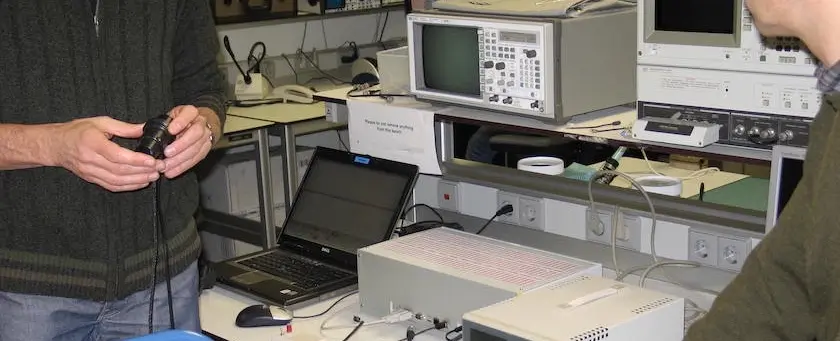
It was, in many ways, an inspiring environment. A mix of physicists thinking in equations, clinicians and medical biologists working together on new diagnostic approaches — all focused on turning an idea into something tangible. The image at the top of this page captures that inspiring moments quite well.
Could things have been structured differently? Yes.
If we had approached it with more experience — and more resources — we might have chosen another path. We could have funded the additional research ourselves, including the work needed to validate the combination of technology and application. Based on that, we could have filed a patent application in our own name, with the university researchers listed as inventors.
But that would have required both insight and capital. At the time, we had neither in sufficient measure.
So while the outcome was not fully on our terms, it was not a bad outcome either. In fact, it was a workable and constructive starting point. Developing something new is difficult enough as it is. Collaboration requires a certain level of mutual benefit — and a willingness to allow each party to secure their position.
What This Case Teaches About Prior Art, Timing, and Ownership
For first-time founders, especially those coming from a technical background, this type of situation is more common than you might expect. The underlying dynamics are not always visible at the moment they matter most.
Looking back, several lessons stand out.
-
Existing technology does not mean there is no patent opportunity.
The core research had already been published, which meant it was part of the public domain. But the specific application of that technology was still new — and therefore potentially patentable. This is a crucial distinction. (See also: What is prior art?) -
Timing matters more than intent.
We did not intend to “give away” anything. But by openly discussing our idea before thinking about protection or structure, we created a situation where others could act faster and more strategically. -
Informal discussions are not neutral.
Even in early, exploratory conversations, you are sharing information that may have strategic value. An NDA is not a guarantee, but it can change the timing and framing of what happens next. -
Patents define control, not just ownership.
The patent did not stop us from moving forward — but it did define the terms under which we could do so. Access became conditional, and that shaped the structure of the company from the start. -
Patent strategy is part of building a company.
At the time, we saw patents as something that would come later. In reality, decisions about intellectual property are often intertwined with the earliest stages of venture creation. (See also: How to patent an idea) -
Professional counterparts will think ahead — even if you don't.
Technology transfer offices and experienced institutions are used to securing positions early. That is not opportunistic behavior — it is part of their role.
None of this means that you should avoid sharing ideas or collaborating with universities. On the contrary — many successful ventures are built exactly in that way.
But it does mean that understanding how value is created, claimed, and structured is just as important as the idea itself.
Because in the end, innovation is not only about what you build — but also about the position you create while building it.
Discover More Innovation Case Studies
Every innovation has its own story, but many of the lessons are universal. Explore our growing collection of Innovation Case Studies covering startup journeys, intellectual property strategy, licensing, investment decisions and real-world founder experiences. You can also browse our dedicated Founder Lessons collection, where I share the strategic decisions, mistakes and turning points that shaped the ventures I was involved in.